Every healthcare visit shouldn’t feel like starting again.
The problem isn’t the care — it’s the continuity. Between appointments, what patients said, felt and understood fades. Clinicians meet the same person but start from scratch. Caregivers carry the burden of remembering alone.
Fragmented care
Electronic Health Records capture clinical events — but not what happens between them. Patients arrive unprepared, leave confused, and lose track of what was said.
Continuity of care
Trusted Health Memory preserves what matters between encounters — so every visit builds on the last, patients feel known, and clinicians have context before they ask.
Why Trusted Health Memory Matters
Helping every patient feel known
“I don’t mind seeing someone new. I mind having to explain my life all over again.”
Home Companion exists to reduce that burden. It helps patients arrive prepared. It helps clinicians begin with context. It helps conversations move forward instead of starting again.
- ✓ Feel known
- ✓ Remember what matters
- ✓ Prepare better
- ✓ Stay engaged
- ✓ Tell their story once
- ✓ Understand the person before treating the patient
- ✓ Spend less time searching
- ✓ Start consultations with context
- ✓ Have better conversations
- ✓ Make more informed decisions
- ✓ Better continuity of care
- ✓ Better patient experience
- ✓ Evidence before scale
- ✓ Governed AI
- ✓ Human authority
What Trusted Health Memory makes possible
A simple flow — from the patient’s voice to a better conversation with their clinician.
“When clinicians already know my story, I feel like a person — not just another patient.”
The experience Trusted Health Memory is designed to create.
Care doesn’t stop at the clinic door — and neither should your memory of it
Most of care happens between visits — and most of it is forgotten. Home Companion builds a Trusted Health Memory that travels with the person before, during and after every encounter: helping them prepare for visits, understand care plans and carry what matters forward, while clinicians stay in control.
Not a scribe. Not remote monitoring. Not a patient portal. A governed companion for the human experience around every visit.
Continuity of Care
Continuity means the people looking after you already know enough about your story that you don’t have to keep starting again. Trusted Health Memory™ helps your story travel safely with you.
Fragmented Care
Different healthcare professionals often only see little pieces of your story instead of the whole picture. Trusted Health Memory™ helps reconnect those pieces.
Coming soon · The full continuum of care
Home Companion and MyHealthCanvas work independently today — one governed experience across the whole care cycle is coming soon.
Where Home Companion helps today
Prepare with a memory that’s ready
Before important visits, Home Companion helps patients walk in prepared — nothing important forgotten:
- Track concerns
- Capture caregiver observations
- Prepare questions
- Organise information in MyHealthCanvas
Understand and carry it forward
After appointments, Home Companion helps patients hold on to what was said:
- Review next steps
- Organise information
- Update MyHealthCanvas
- Stay on track between visits
Inform, remember, organise, explain, document and escalate — never decide.
Home Companion never diagnoses, never changes medication, never suggests treatment, and never triages on its own. Every boundary is enforced and audited by PCC-SafetyOS™. Your clinician stays in command.
We believe Trusted Health Memory can improve continuity of care — by helping patients prepare, remember, understand and carry information forward between appointments.
That is the hypothesis a hospital pilot is designed to test.
Hospital Innovation Pilot
Generating the first real-world evidence that Trusted Health Memory can improve continuity of care, patient experience and appointment preparedness — while preserving human authority. A 30–90 day evaluation with no software purchase and no changes to clinical workflows.
Looking for Hospital Innovation Partners
We are inviting healthcare organisations to co-design prospective real-world evidence for AI-enabled continuity of care through no-cost innovation partnerships.
Pilot partners receive
- ✓Home Companion deployment
- ✓Patient onboarding and training
- ✓Governance framework
- ✓Joint evidence generation
- ✓Opportunity for co-authorship on resulting publications
- ✓Design guidance
Pilot structure
- ✓30–90 day pilot, 50–200 patients
- ✓Complex-care patients (e.g. oncology, geriatrics)
- ✓No software purchase — a simple URL to the Home Companion web app plus the MyHealthCanvas PDF form (free Adobe Reader)
- ✓No changes to clinical workflows or standards of care
- ✓Joint clinical evaluation
Evidence generated
- ✓Patient engagement
- ✓Appointment preparedness
- ✓Conversation continuity
- ✓Patient experience
- ✓Trusted Health Memory™ creation
- ✓Governance & auditability
- ✓Human authority demonstrated
The hospital receives
- ✓Joint evidence report
- ✓Governance evaluation
- ✓Deployment recommendations
- ✓Publishable real-world evidence — your research team can be lead author
Pilot governance
- ✓Patient-owned, consent-based participation
- ✓GDPR & EU AI Act aligned by design
- ✓Human authority over every AI action
- ✓Full audit trail of every AI-assisted interaction
- ✓No changes to workflows or standards of care
4,600+ governed AI interactions completed in residential care. Hospital pilot recruitment now underway.
We provide the Home Companion web app, the MyHealthCanvas forms, onboarding and training at no cost during evidence generation. The patient collects the data through simple guided voice — and your research team can be lead author on the resulting white paper.
Start the conversation
Tell us about your organisation and what you are trying to achieve. We will respond within two working days.
Home Companion is not being marketed as a finished clinical product. We’re looking for teaching hospitals and innovation partners who want to help determine whether Trusted Health Memory can improve continuity of care for people living with chronic illness. Together we’ll generate the evidence needed to decide what should come next.
The future of healthcare AI is not autonomous systems operating alone.
It is Human Authority.
Governed AI, operating in real-world environments in early testing, ahead of clinical expansion.
Current Pilot Testing — Operational Metrics
Operational numbers from current pilot testing — Basel.
Honest scope: These observations come from an informal early-feedback arrangement at a single care setting in Basel, via a care professional. This is not yet a formal institutional pilot. Figures are tester-observed and shown to illustrate feasibility, not clinical efficacy.
Early Real-World Evidence (RWD)
Home Companion is already generating operational evidence in real-world home environments — before hospital deployment.
- Human–AI interaction, bounded
- Safe human escalation
- Trusted Health Memory
- Governance audit trail
- Patient engagement
- Patient-owned history
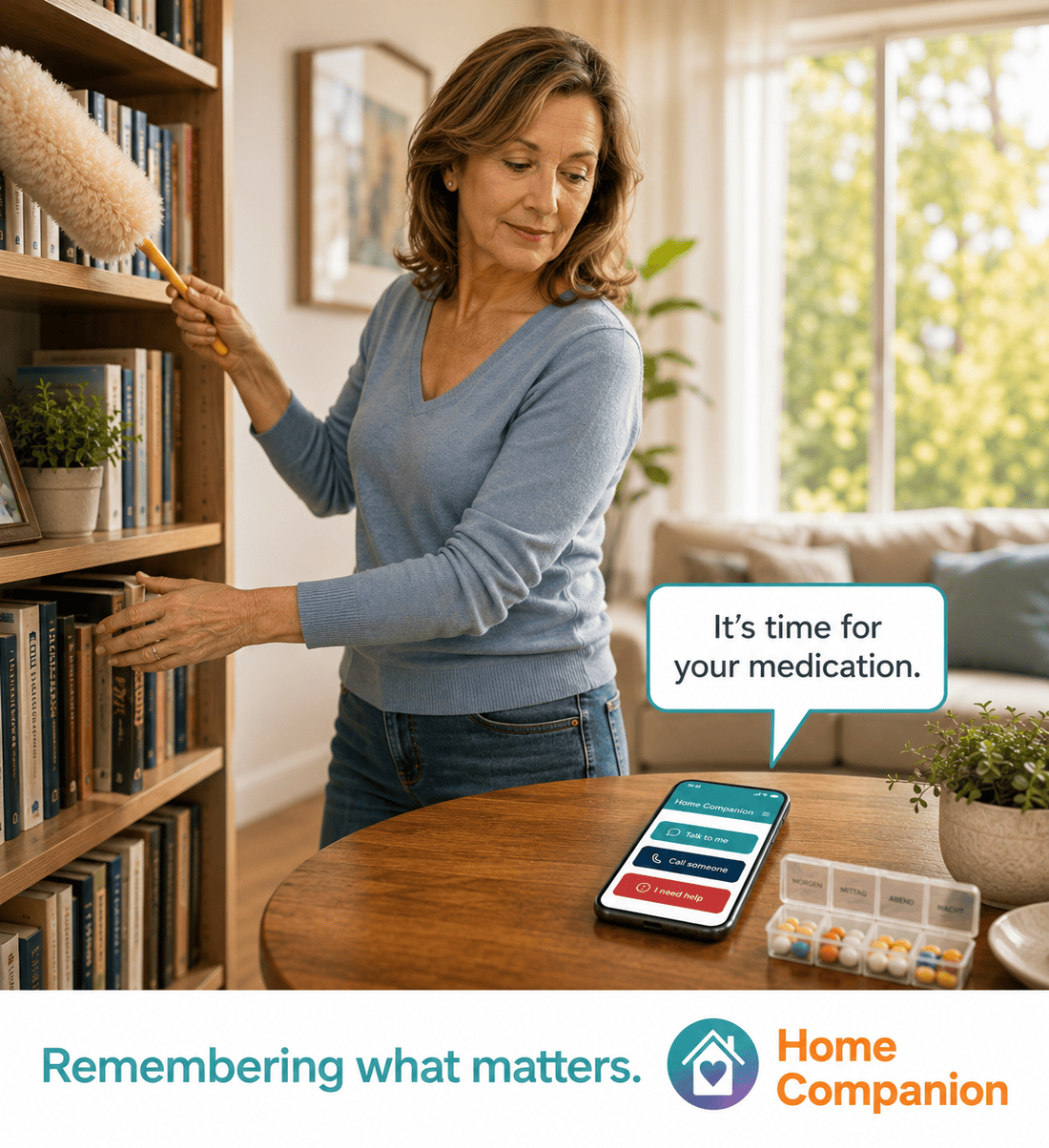
Home Companion in live residential care — voice-native and governed
Current pilot evidence — signals we are observing, not yet clinical claims
Building early real-world evidence before scaling into hospital care.
Where Home Companion Creates Value
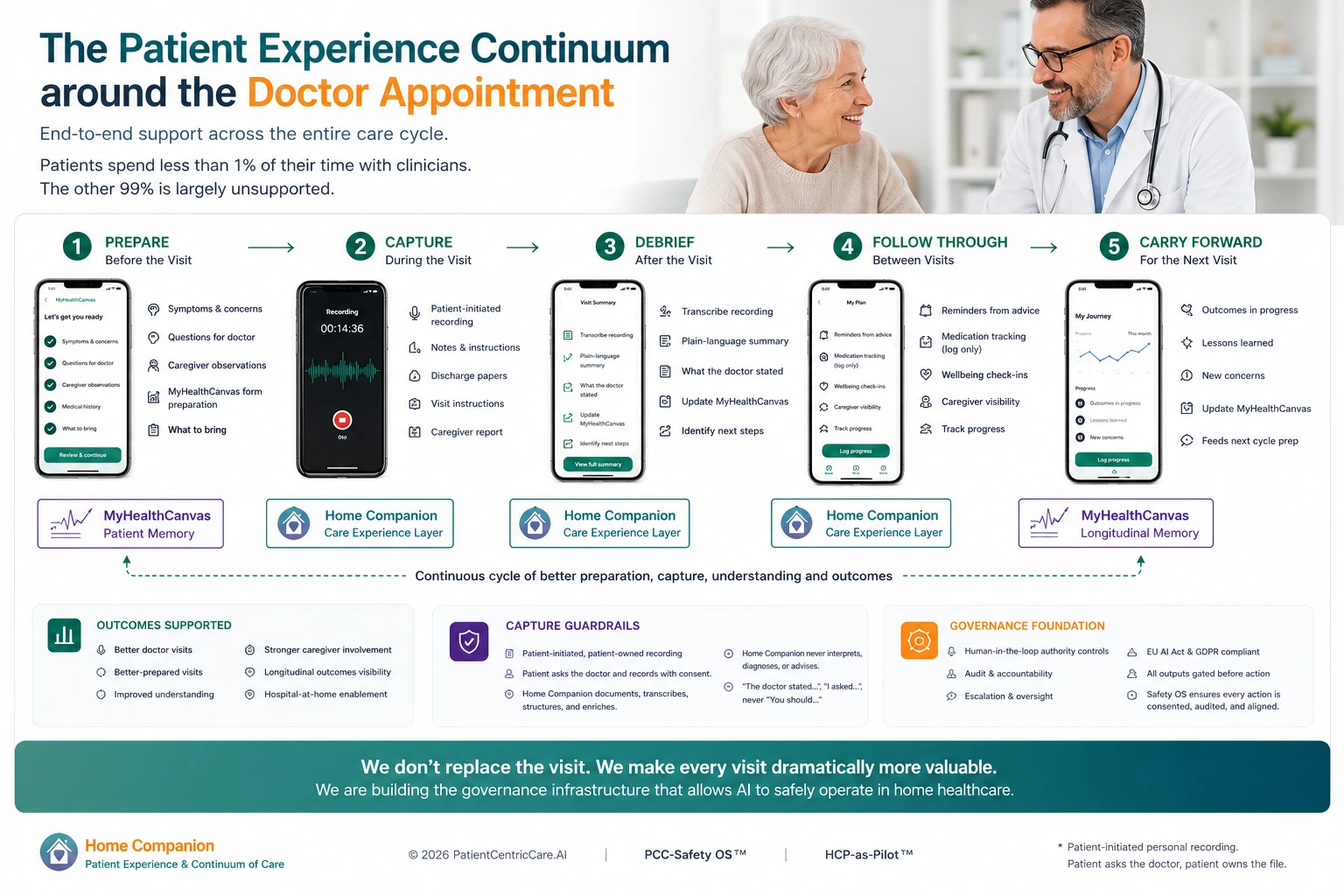
The specialist & chronic-care journey across the continuum of care — from preparation to carry-forward into the next visit.
Specialist & Chronic Care Pathways
Oncology follow-up · cardiology review · diabetes & respiratory clinics
Prepare — patient arrives ready, with questions and history to hand
Capture & Debrief — what mattered from the visit is retained, not lost
Follow Through — between encounters, the plan stays on track
Carry Forward — a structured patient memory into the next visit
See the governance model in action
Apply for a 30-Day Pilot →Download the Governance & Data Stewardship Brief ↓
View Hospital Pilot Framework ↓
Trusted Health Memory, built on a governed foundation
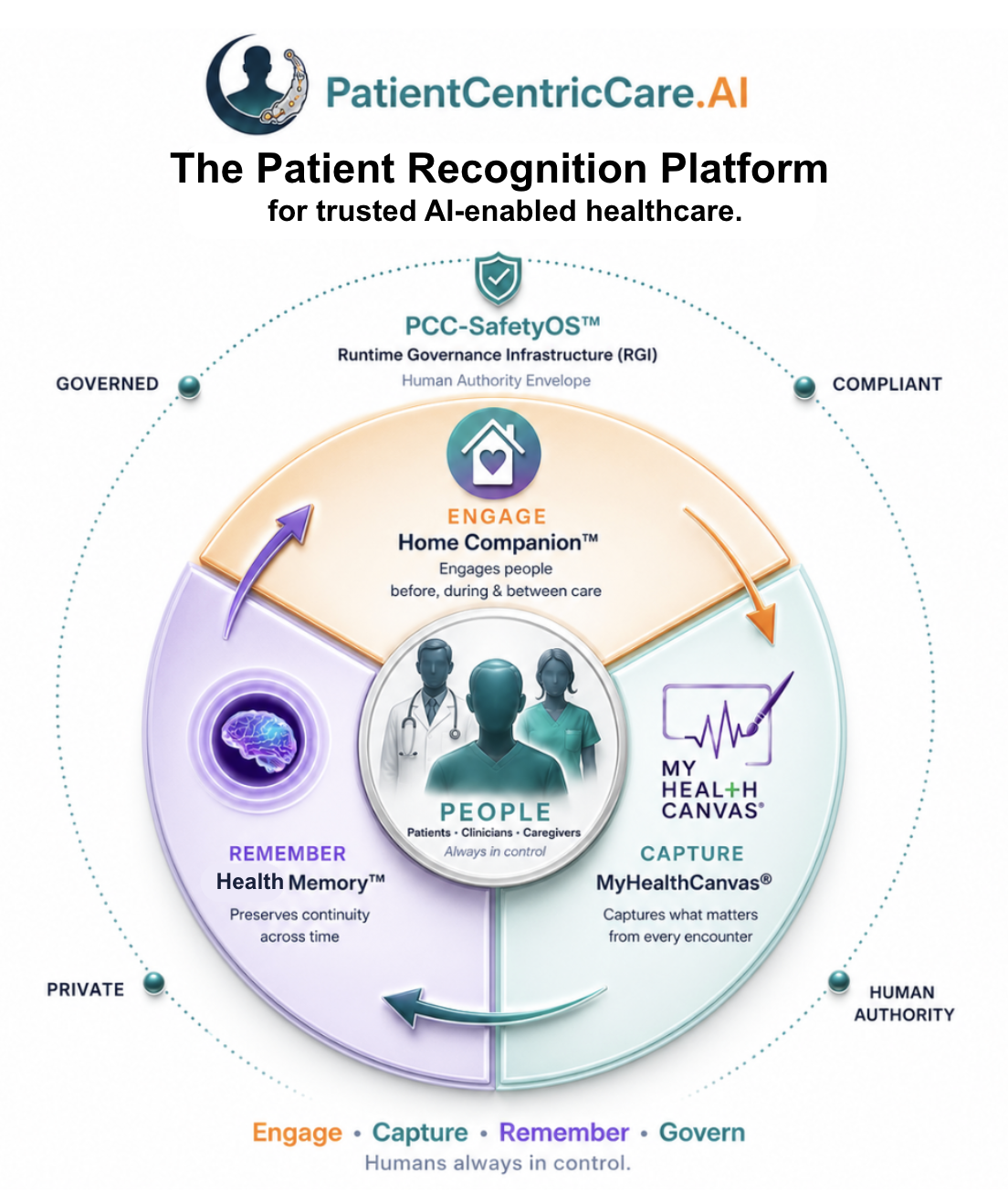
One platform, four roles — Engage with Home Companion, Capture with MyHealthCanvas, Remember with Trusted Health Memory, and Govern every action with PCC-SafetyOS.
Engage
Home Companion™
Voice-first AI engagement application. Engages patients before, during and between encounters — strategically non-medical.
Capture
MyHealthCanvas®
Structured patient capture — symptoms, medications, questions, priorities and outcomes. Patient-owned.
Remember
Trusted Health Memory
Persistent, patient-owned longitudinal memory that grows richer with every interaction — the continuity layer EHRs cannot create.
Govern
PCC-SafetyOS™
Governed by PCC-SafetyOS™ — consent, auditability and human oversight on every AI-assisted action, EU AI Act-aligned.
Flight Recorder
Tamper-evident audit trail — every interaction classified, timestamped, and stored.
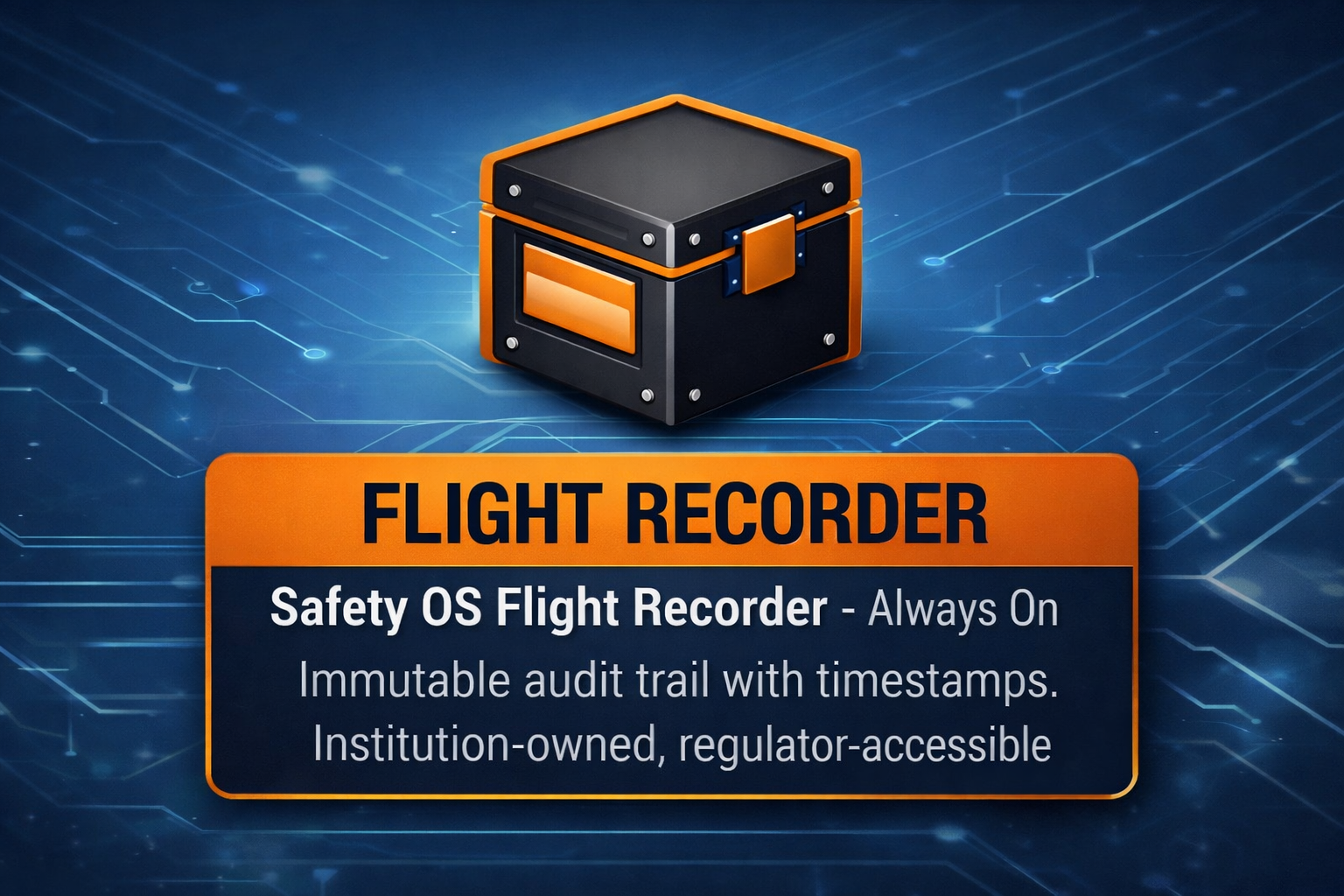
- Every AI action recorded with authority level
- Consent status verified before escalation
- Boundary refusals logged with context
- Regulatory-ready evidence for EU AI Act compliance
Same audit standard regulators will require for high-risk AI.Built from day one — not retrofitted.
Acoustic Privacy by Design
Voice interactions processed locally. Raw audio never stored. Only governance metadata is retained.
- No cloud recording of conversations
- Only structured metadata logged (consent, escalation, authority)
- GDPR and UK data protection compliant
- Patient retains full control over data sharing
Human Authority — the operating model behind Home Companion — read more
The question is no longer whether AI can perform tasks — it’s whether humans can govern increasingly capable agent teams safely and accountably. Human Authority keeps humans accountable for outcomes while AI executes delegated tasks within defined boundaries.
One stack, three layers: Human Authority defines the model, HCP-as-Pilot™ keeps a clinician in command, and PCC-SafetyOS™ enforces it at runtime — with Home Companion applying it across the continuum of care.
Governance architecture — how every interaction is governed — read more
Every patient interaction passes through seven governance layers before reaching the patient — across the continuum of care.
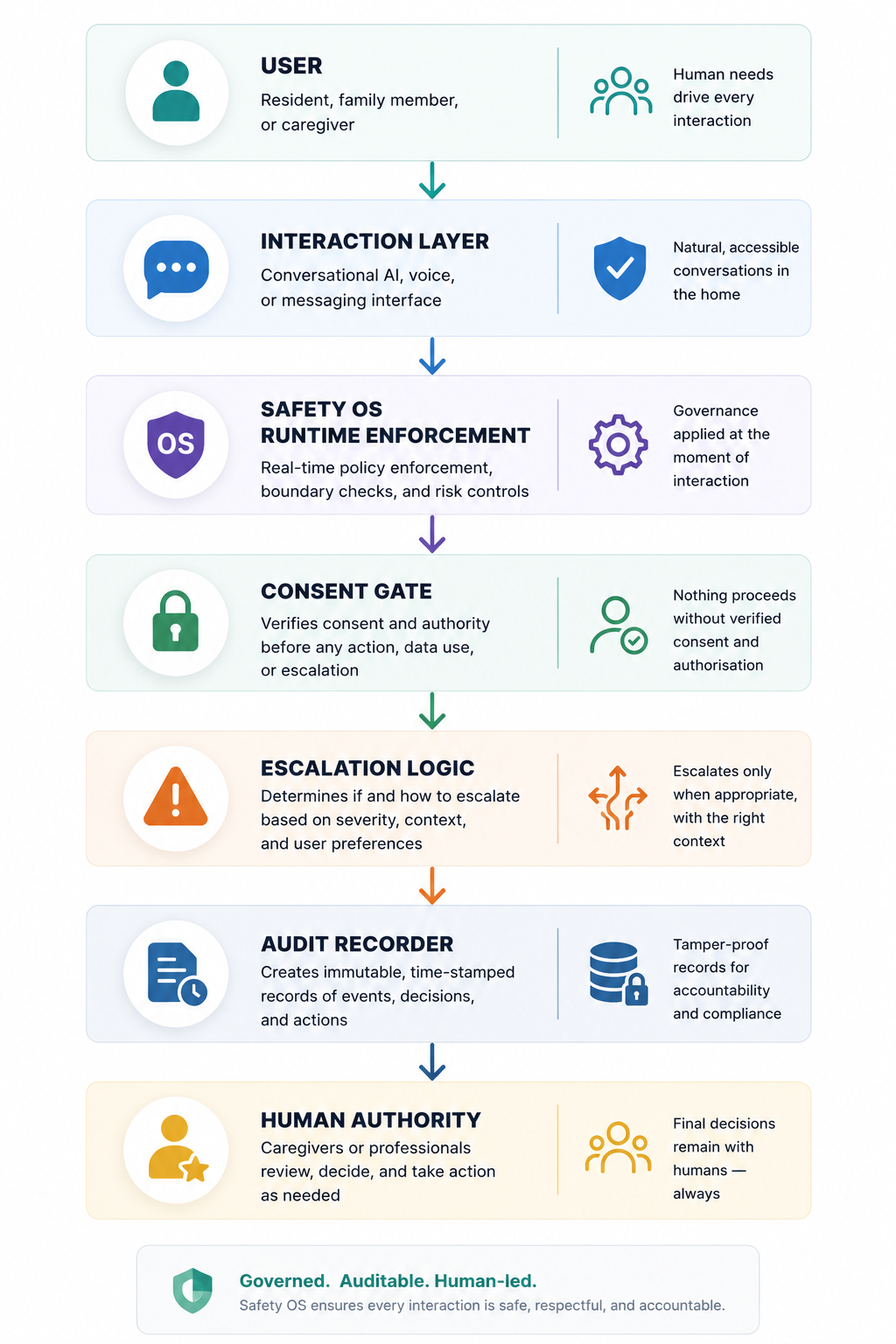
Governed. Auditable. Human-led. Every interaction is designed to be safe, respectful, and accountable — and logged so it can be checked.
Why now — the governance window — read more
Regulatory inevitability creates a narrow window for first-mover advantage.
How it scales — only when governance is proven — read more
Governance maturity unlocks capability expansion. Never the reverse.
Phase I
Non-medical companionship. Governance proof.
Phase II
Structured wellbeing monitoring. Expanded boundaries.
Phase III
Clinical-grade integration. Regulatory inheritance.
- Each phase requires demonstrated governance maturity from the previous
- Regulatory inheritance: evidence from Phase I directly supports Phase II authorization
- No capability expansion without proven safety at the current tier
Why we start non-medical — read more
Deliberate scope constraint that accelerates the long-term regulatory pathway.
Faster Deployment
Non-medical scope avoids SaMD classification, enabling immediate real-world deployment and evidence generation.
Governance Evidence
Every interaction generates the audit data regulators will require for higher-risk AI — built before it’s mandated.
Evidence Builds Forward
Phase I evidence directly supports Phase II/III authorization — governance maturity compounds over time.
Why we believe Trusted Health Memory is worth testing
These studies don’t prove Home Companion works. They support the hypothesis that structured conversation and continuity deserve rigorous evaluation.
Emerging peer-reviewed evidence suggests that AI-enabled care calls and structured conversation may support memory, mood and social connection in older adults. Home Companion is designed around that principle — while remaining non-medical: it does not diagnose, treat or replace clinical care.
AI care calls and dementia
A 2025 Scientific Reports study of community-dwelling individuals with dementia found regular AI care calls were associated with improved memory scores and reduced depressive symptoms.
Design implication: consistent, supportive conversation may be more valuable when delivered regularly and personally.
Kang et al., Sci Rep 15:27116 (2025) ↗Structured conversation and cognition
The I-CONECT randomised controlled trial of frequent structured video conversations with socially isolated older adults found evidence that conversational engagement may support cognitive and psychosocial outcomes.
Design implication: conversation itself may be a meaningful intervention pathway, especially where loneliness and isolation are present.
Dodge et al., The Gerontologist 64(4) (2024) ↗Human-first interpretation
These studies don’t prove every such system improves outcomes — they point to a credible direction: structured, supportive conversation can matter. We build around that while staying non-medical, governed and auditable.
Home Companion is a non-medical system. It does not diagnose, treat or make clinical decisions. Evidence cited here supports the rationale for conversational engagement and future research, not a claim of clinical efficacy for Home Companion.
If structured conversation can influence memory, mood and connection, then governance is not optional — it is essential. That is why Home Companion is built around Human Authority and PCC-SafetyOS™ from the beginning.
A Memory That Adapts To The Person
Memory-aware, multilingual, culturally adaptive — helping people hold on to the thread of their care, in their own language.
Honest scope: These observations come from an informal early-feedback arrangement at a single care setting in Basel, via a care professional. This is not yet a formal institutional pilot. Figures are tester-observed and shown to illustrate feasibility, not clinical efficacy.
“I wasn’t sure at first, but now it helps me remember what I want to ask before I see the doctor — and what was said afterwards. In my own language, at the right time.”
— Resident, Basel pilot
“I remember my appointments better. It reminds me gently, in my own language, at the right time.”
— Resident, Basel pilot
“My daughter worries less now. She knows the important things won’t be forgotten, and that if something goes wrong, the right person gets called.”
— Resident, Basel pilot
“I don’t lose track of things anymore. It’s not a nurse, it’s not a doctor — it just helps me keep everything straight.”
— Resident, Basel pilot
Value for the wider ecosystem (payers, researchers, families) — read more
Home Companion is designed so that every participant gains — care systems get safe, audit-ready AI; sponsors and researchers gain real-world evidence; families gain governed AI that protects autonomy in the home; and the wider public benefits from healthcare AI that is accountable by design.
Explore the Ecosystem & Sponsorship Model →Resources & downloads — read more
Access detailed documentation on Home Companion
Human Authority — Early Evidence
Real-world deployment evidence from Home Companion™
Download PDFGovernance & Data Stewardship Brief
How the platform is governed at runtime, what data is stored, who can access it — and the proposed hospital pilot design
Download PDF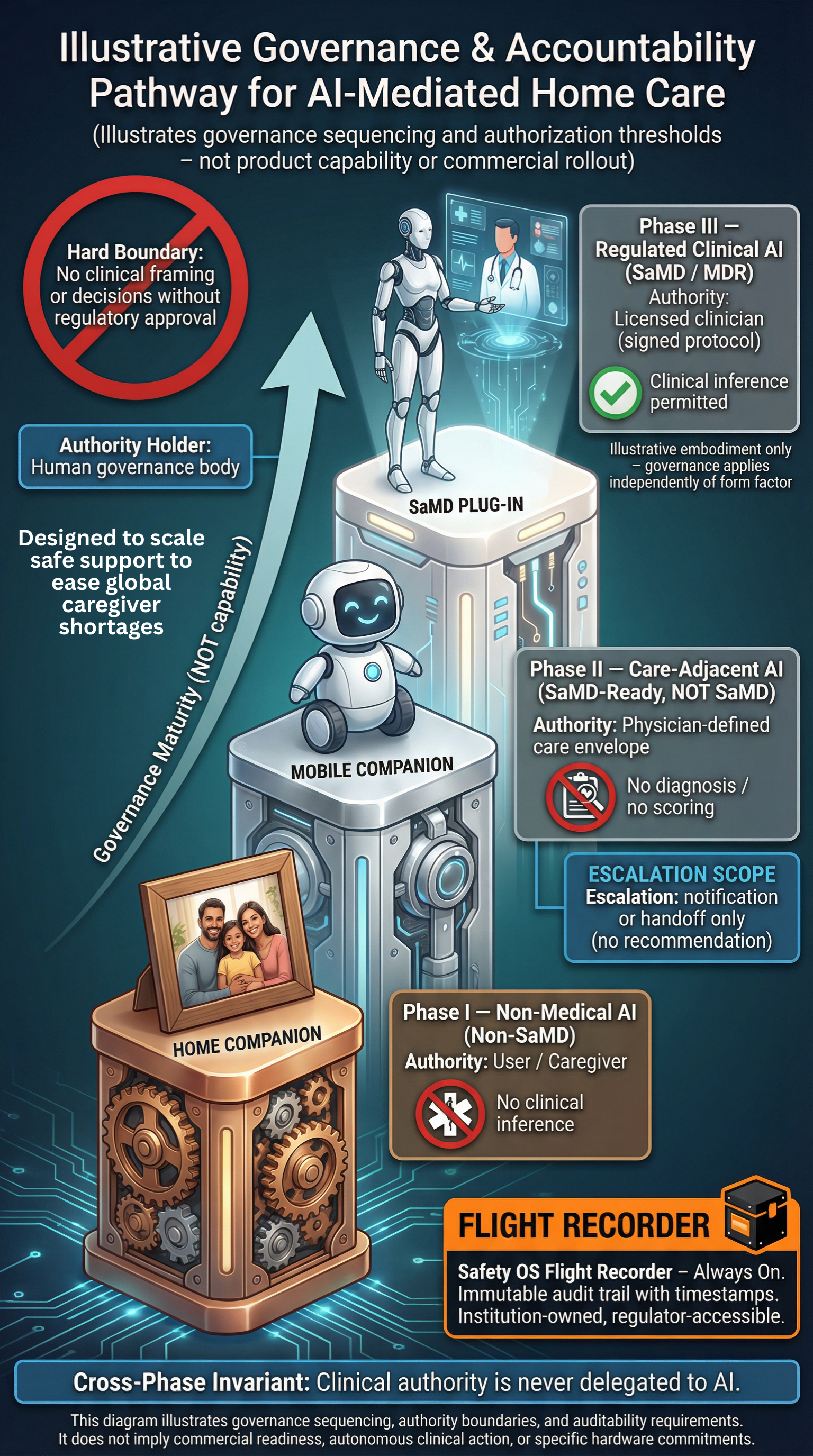
3-Phase Roadmap
Visual representation of the governance maturity progression
Download PNGHome Companion also supports independent adults and families directly. → See Home Companion for individuals and families
Built to extend — only as governance matures
Phase I demonstrates governance in non-medical environments.
Phase II is intended to extend Human Authority into HCP-as-Pilot™ workflows — with EHR integration, clinical escalation pathways and regulated care environments, subject to regulatory review and formal authorization.
Each phase expands capability only after governance maturity has been proven.
Important Notice: Home Companion is a non-medical system. It does not provide diagnosis, treatment, or clinical decision-making. Escalation is permitted only with user consent and subject to governance controls. Future phases are subject to regulatory review and formal authorization.